In modern urban environments, the challenges faced by city councils are increasingly complex and interconnected. They require solutions that serve multiple functions—from providing essential public amenities to mitigating environmental risks. A new paradigm is emerging where infrastructure and recreation are not mutually exclusive, but are rather two sides of the same coin. This is the essence of a truly ludic space: a public realm that is not only designed for play and rest but is also engineered to solve critical urban issues, such as stormwater management.
A recent garden recovery in Valencia serves as a prime example of this integrated approach. The project had a dual mission: to revitalize an underutilized public park and, simultaneously, to address the persistent problem of surface runoff that was flooding a lower-lying football field. This case study demonstrates how smart design, guided by the principles of pluvial retention, can transform a liability into a valued community asset.
Sustainable Drainage Systems: A Foundational Approach to Urban Design
The success of any modern urban project hinges on its ability to integrate with its environmental context. In the case of this garden recovery, the primary challenge was the effective management of rainwater runoff. The solution was not a simple drain, but a sophisticated system of pluvial retention designed to infiltrate water back into the ground, reducing the load on municipal drainage systems and preventing downstream flooding.
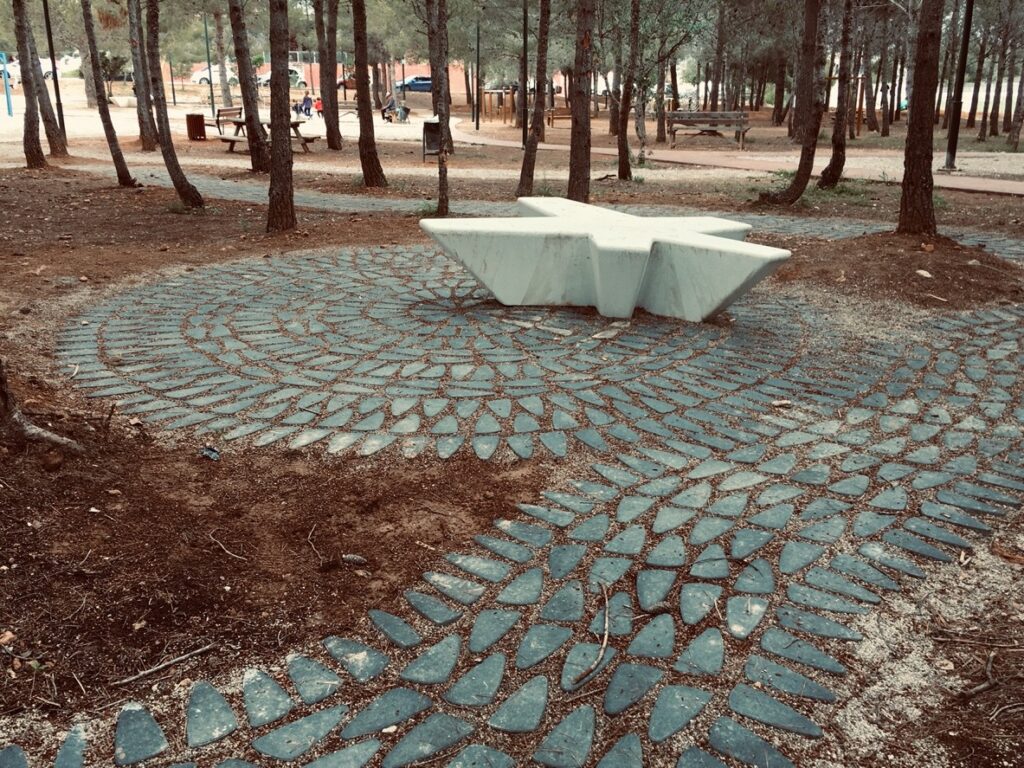
The design team created a network of permeable pathways, some existing and some new, that act as a collection system. These draining paths channel rainwater away from sensitive areas, directing it towards a strategically placed gravel bed. This bed serves as a natural infiltration basin, slowly returning the water to the deeper soil strata. By embedding this system directly into the park’s circulation plan, the project demonstrates that sustainable infrastructure can be a foundational element of public space design, not merely an afterthought. It is a testament to the idea that intelligent planning can serve both ecological health and community needs.
Designing the Ludic Space: Integrating Play and Topography
The genius of the project lies in how the engineering solution for pluvial retention became an integral part of the park’s recreational design. The space was transformed into a ludic space that offers a variety of experiences, from quiet contemplation to active play, all while serving its primary environmental purpose.
Reimagining Play Surfaces for Safety and Sustainability
The new play areas were designed with both safety and sustainability in mind. The existing concrete slab was repurposed, but the old play equipment was replaced with modern, safer alternatives. More importantly, the new installations—like a zipline and a large climbing structure—were built on a base of sand and draining gravel. This permeable surface is directly connected to the larger SUDS infiltration system, ensuring that rainwater is collected and managed even in the most active areas of the park. This seamless integration of play and infrastructure is a hallmark of truly innovative urban design.
Harnessing Topography to Enhance the Playful Space Design
The project’s most creative intervention involved modifying the landscape to increase its slope. This might seem counterintuitive, but it allowed for the integration of exciting features, such as hillside slides that flow naturally with the terrain. By transforming a functional grade into a play element, the design team created a unique and dynamic experience. Furthermore, a new accessible ramp was strategically developed to connect the sidewalk with the playground, ensuring that the new ludic space is welcoming and usable for people of all mobilities.
Microclimates and Comfort: The Role of Strategic Planting
A truly great public space is one that is not only functional but also comfortable and inviting. The project’s team addressed this by making a crucial change to the park’s tree canopy. They replaced existing pine trees with mulberries, a species that provides superior solar control. This deliberate choice creates natural urban shade over the new recreational areas, ensuring that the space remains a pleasant refuge even on the hottest days. This attention to detail, from macro-level drainage to micro-level solar control, is what defines a successful garden recovery in Valencia and underscores the value of a holistic design approach.
The dual success of this project—its ability to solve a complex engineering problem while simultaneously creating a beautiful and functional community space—sets a new standard for urban planning. It demonstrates that the most effective solutions are those that are integrated, sustainable, and designed with people and their environment at the forefront.
Your council has the opportunity to transform challenges into assets. A multi-mission project like this requires specialized knowledge in landscape architecture, civil engineering, and sustainable design. Contact us to discuss how we can help you turn your next urban challenge into a valuable community space.